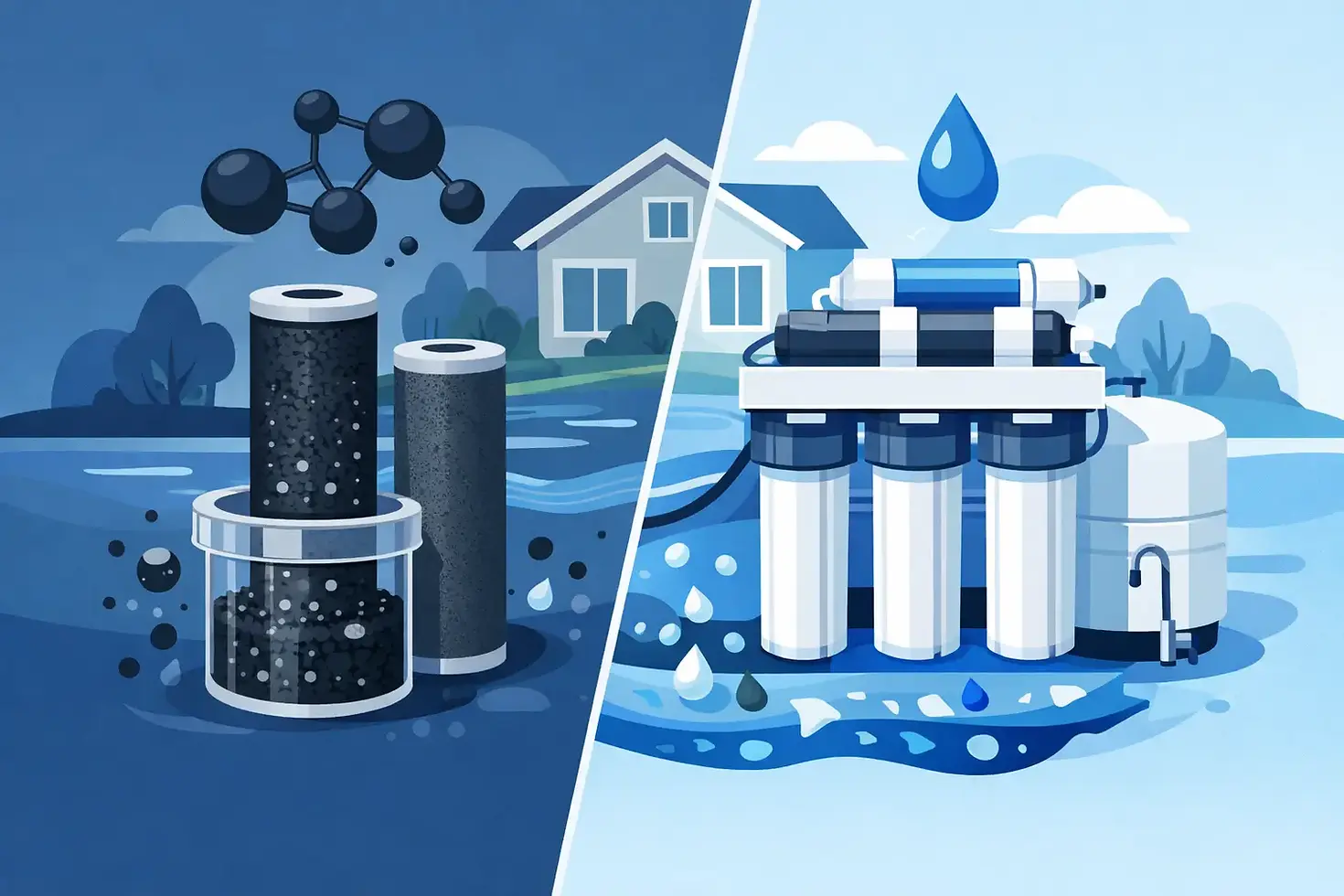
Carbon Filtration vs Reverse Osmosis for Your Home
A glass of water can taste perfectly acceptable and still leave questions unanswered. Does chlorine affect the way your shower feels? Are you filtering only drinking water while every other tap remains untreated? In the carbon filtration vs reverse osmosis decision, the right answer is rarely one technology replacing the other. It is about matching the treatment method to the water you use, the contaminants you want to reduce and the standard of living you want throughout your home.
For many NSW households, carbon filtration is the foundation for better whole-home water, while reverse osmosis is a specialised choice for exceptionally refined drinking water. Both can play a valuable role, but they work in very different ways.
Carbon filtration vs reverse osmosis: the key difference
Carbon filtration uses activated carbon, a highly porous material with a large surface area. As water passes through it, many unwanted compounds are attracted to and held within the carbon. This process is particularly effective for improving the taste and odour of treated town water.
Reverse osmosis, often called RO, works by pushing water through a very fine semi-permeable membrane. The membrane separates water from a broad range of dissolved substances, sending a portion of water to the drain while retaining purified water for use. It is a more intensive process, usually installed at a single drinking-water point such as the kitchen sink.
In simple terms, carbon is excellent at treating the chemicals that make water smell or taste unpleasant. Reverse osmosis is designed to reduce a wider range of dissolved contaminants. Neither is automatically better in every situation.
What carbon filtration does well
A quality carbon system is especially suited to municipally treated water. Chlorine is commonly used to disinfect town supplies, and it can be noticeable in drinking water, showers and steam from a hot bath. Carbon filtration can substantially reduce chlorine, creating water that tastes fresher and feels more pleasant for everyday use.
Some systems are also designed to reduce chloramines, pesticides, herbicides, volatile organic compounds and selected PFAS compounds. However, not all carbon is the same. The type of carbon, contact time, water flow, cartridge size and filter design all influence performance. A small tap filter and a professionally specified whole-home system should not be treated as equivalent solutions.
For a family home, whole-home carbon filtration has a practical advantage that is easy to overlook: it treats more than the water in your glass. It supports cleaner water at showers, basins, laundry taps and appliances. That matters when your household is concerned about chlorine exposure through bathing, wants to protect fixtures from sediment, or simply wants every tap to deliver a more enjoyable water experience.
Carbon systems can also be configured as part of a multi-stage setup. Sediment filtration is often installed before carbon to capture dirt, rust and fine particles, helping protect the carbon media and maintain better flow. Depending on the property and water source, further stages may be appropriate.
Carbon filtration has limits
Carbon does not remove everything. It is not generally the best standalone option for dissolved salts, hardness minerals, fluoride, nitrates or many heavy metals. Its performance also declines as the media becomes exhausted, which is why timely cartridge changes and professional maintenance matter.
Carbon filtration is also not a substitute for disinfection where microbiological safety is a concern. Homes using rainwater, for example, may require carefully designed sediment filtration and UV sterilisation to address microbial risks. The water source should always guide the system design.
Where reverse osmosis excels
Reverse osmosis is valued for the exceptionally refined water it can produce at a dedicated outlet. Because the membrane has extremely small pores, an RO unit can reduce many dissolved solids and contaminants that carbon alone may not address, including fluoride, nitrates, certain heavy metals and salts.
Most undersink RO systems use several stages rather than the membrane alone. Water typically passes through sediment and carbon pre-filters first, which protect the membrane by reducing particles and chlorine. The membrane then performs the fine separation, and a final carbon stage may improve the taste before water reaches the separate drinking-water tap.
This makes RO a compelling choice for homeowners who want a higher level of purification for drinking, cooking, tea, coffee and baby formula preparation. If water has a high mineral content, a noticeable dissolved-solids reading or a specific issue identified through testing, reverse osmosis may offer a meaningful additional layer of reassurance.
The trade-offs of RO
Reverse osmosis is powerful, but it is not usually the practical answer for every tap in the house. It produces water more slowly than a whole-home carbon filter and needs a storage tank or tankless system designed around household demand. It also creates reject water as part of the filtration process, although more efficient modern units can reduce the amount compared with older designs.
RO removes beneficial minerals as well as unwanted dissolved substances. For this reason, some homeowners choose a system with a remineralisation stage, which restores selected minerals for a more balanced taste. The best choice depends on your preferences, water chemistry and the quality of the individual system.
There is also a maintenance commitment. Pre-filters, post-filters and membranes need replacement on schedule. Neglecting service can affect taste, flow and filtration performance, so ongoing support should be part of the purchase decision rather than an afterthought.
Which system is right for an Australian home?
If your main concern is chlorine taste and odour, or you want more pleasant water from every shower and tap, a whole-home carbon filtration system is often the natural starting point. It provides a broad household benefit without confining better water to one kitchen outlet.
If your priority is reducing a wider range of dissolved substances in the water you drink, an undersink reverse osmosis system may be the stronger choice. It is particularly useful when a water test identifies specific dissolved contaminants, or when you prefer the taste of very low-mineral water.
For many premium homes, the best approach is both: whole-home filtration at the point where water enters the property, paired with reverse osmosis at the kitchen sink. The whole-home system manages chlorine, sediment and other relevant contaminants before water reaches showers, appliances and taps. RO then provides an added level of refinement for drinking and cooking water.
That combination avoids asking one system to do a job it was not designed to do. It also means you are not wasting highly filtered RO water on flushing toilets, washing clothes or watering the garden.
Start with your water, not a product brochure
Water quality is not identical across NSW. Town water treatment methods can vary, and homes on rainwater, bore water or mixed supplies have different requirements again. Plumbing condition, water pressure, household size and the number of bathrooms also affect what system will perform well in your home.
A considered recommendation begins with your concerns and your water source. If PFAS, heavy metals, microplastics, chloramines or bacteria are on your mind, ask what the proposed system is specifically designed to reduce and under what conditions. Look for clear performance information, suitable flow rates and a maintenance plan that protects the investment.
It is equally sensible to consider where you notice the problem. A chlorine smell in the shower points towards whole-home treatment. White scale around taps may suggest mineral content that requires a different strategy. A desire for highly purified drinking water may make RO a worthwhile addition, not necessarily a replacement for entry-point filtration.
Better water should work quietly in the background
The strongest water treatment systems are not chosen because they have the longest list of claims. They are chosen because they suit the home, the water supply and the people living there. Carbon filtration can transform the everyday experience of water across your property, while reverse osmosis can provide a more refined option exactly where it matters most.
If you are weighing carbon filtration vs reverse osmosis, begin with the outcome you want at each tap. Cleaner showers, better-tasting water, protection for appliances and confidence in your drinking water can sit within one carefully designed solution. Because every drop deserves to be pure, clean and healthy.


Comments