Choosing a PFAS Water Filter for Your Home
PFAS are not something you can see, smell or taste in a glass of water. That is what makes choosing a PFAS water filter feel more complicated than buying a filter simply to improve chlorine taste. For families who want greater confidence in the water used for drinking, cooking, bathing and washing, the right solution starts with understanding what PFAS are, how filtration works and where treatment belongs in the home.
What are PFAS and why are homeowners concerned?
PFAS is short for per- and polyfluoroalkyl substances, a large group of manufactured chemicals used for decades in products designed to resist water, oil, grease and heat. They have been used in applications ranging from firefighting foams to some food packaging, textiles and industrial processes.
They are often called “forever chemicals” because many PFAS break down very slowly in the environment. They can move through soil and waterways, which means they may enter drinking water sources in some areas. Australian drinking water is treated and monitored by water authorities, but PFAS concerns have understandably led many homeowners to seek an added layer of protection at home.
The risk profile is not identical in every suburb or for every water supply. It depends on the source water, local catchment conditions, the particular PFAS compounds present and the level detected. A premium filtration system should therefore be selected around your household’s water quality, usage and goals - not a one-size-fits-all claim.
How a PFAS water filter works
A PFAS water filter does not usually rely on one simple screen. PFAS compounds are extremely small, so effective reduction requires a filtration medium that can capture, bind or separate them from the water.
Activated carbon filtration
High-quality activated carbon is widely used to reduce many organic contaminants, including certain PFAS compounds. The carbon has a highly porous surface that adsorbs contaminants as water passes through it. Think of adsorption as contaminants sticking to the surface of the filtration media rather than being strained out like sediment.
The quality of the carbon, the volume of media, water flow rate and contact time all matter. A small cartridge may improve water at one tap, but it has limited capacity. A properly designed point-of-entry system has more filtration media and can be engineered to treat the higher flow rates required for an entire home.
Ion exchange media
Some systems use specialised ion exchange resins alongside activated carbon. These media can be particularly useful for targeting certain PFAS compounds and may improve performance where water chemistry or contaminant levels make carbon alone less suitable.
Like any filtration media, resin needs professional sizing and timely replacement. Once its treatment capacity is used, performance can decline. This is why ongoing maintenance is not an optional extra. It is part of having cleaner, healthier water over the long term.
Reverse osmosis for drinking water
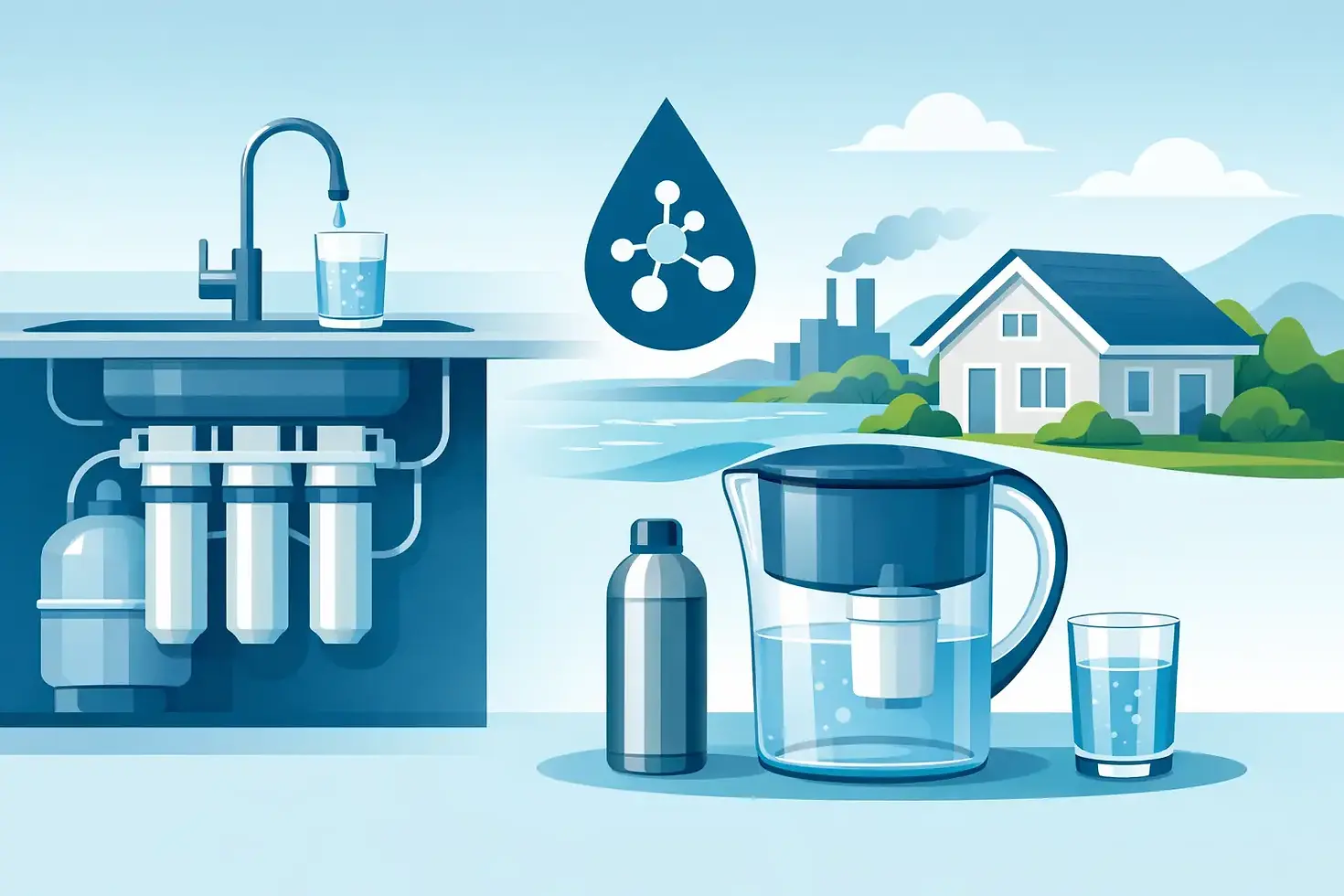
Reverse osmosis, often installed beneath the kitchen sink, uses a fine membrane to separate a broad range of dissolved contaminants from drinking water. It can be an excellent option for households seeking an additional level of treatment for drinking, cooking and baby formula preparation.
However, reverse osmosis is not automatically the best whole-home answer. It produces water at a slower rate, requires a dedicated drinking-water tap and sends some water to waste during the purification process. For many homes, a combination can make sense: whole-home filtration for water throughout the property, with reverse osmosis at the kitchen sink for highly purified drinking water.
Why whole-home PFAS filtration deserves consideration
A jug filter or tap-mounted unit only treats a small portion of your household water. That may be enough for someone focused solely on drinking water, but it leaves showers, baths, bathroom taps, laundry water and appliances untreated.
A whole-home system is installed at the point where water enters the property. Every tap then benefits from treated water, including the shower where chlorine odour and skin dryness are often most noticeable. While drinking water is generally the priority when discussing PFAS exposure, whole-home treatment offers a more complete water-quality upgrade and can also reduce other unwanted contaminants, depending on the system design.
This approach is particularly appealing for families who want their water treatment to match the way they actually live. You should not need to remember which tap is filtered when filling a pot, giving the dog water or washing fruit and vegetables.
There is a practical trade-off, though. Whole-home PFAS treatment needs to be correctly sized for the property. A household with several bathrooms, a large family or high peak demand needs sufficient flow, media capacity and plumbing design. An undersized system can restrict water pressure or reduce contaminant contact time when multiple taps are running.
What to look for before buying a filter
The label “PFAS filter” is not enough on its own. Ask which specific PFAS compounds the system has been tested against, at what influent concentration, under what flow conditions and for how long. PFAS is a broad chemical family, and performance can vary between compounds.
Look for credible, independently verified performance data where available. Product claims should clearly distinguish between reduction and complete removal. No responsible provider should imply that every PFAS compound is eliminated in every water condition for the life of every cartridge.
It is also worth considering the broader water profile. In many NSW homes, chlorine or chloramines, sediment, heavy metals, pesticides, herbicides and microplastics may sit alongside PFAS concerns. A multi-stage filtration design can address several priorities in one system, but the configuration should suit the incoming water supply.
Before making a decision, consider these practical questions:
Is the system designed for your household’s water flow and number of bathrooms?
Does it provide clear information about PFAS reduction performance and filter capacity?
What contaminants does each stage address, and what does it not address?
How often will cartridges or media need replacing?
Is professional installation and ongoing support included?
A free in-home water consultation can make these questions much easier to answer. It allows the proposed system to be matched to your plumbing, family size, water usage and filtration priorities rather than chosen from a box on a shelf.
Maintenance protects filtration performance
Even the most advanced filter relies on fresh, correctly maintained media. Carbon and ion exchange media have a finite capacity. Sediment pre-filters also need attention because built-up particles can affect flow and reduce the efficiency of the stages that follow.
Replacement timing depends on water quality, household usage and the system itself. A busy family home will generally use filtration capacity faster than a one-person household. Homes on rainwater, bore water or mixed supplies may need a different maintenance plan again.
Professional servicing brings useful peace of mind. It provides an opportunity to inspect fittings, check pressure, replace consumables and confirm the system is continuing to perform as intended. With whole-home filtration, this protects not only the quality of water at the tap but also the investment in your household plumbing and appliances.
A considered upgrade for healthier household water
Concern about PFAS is a sensible reason to look more closely at what is coming through your taps, but it should not lead to rushed decisions or exaggerated promises. The best solution is one that is transparent about its capabilities, designed for your home and maintained properly after installation.
For homeowners across the Illawarra, South Coast and Southern Highlands, The Water Alchemists can help turn complex water-quality questions into a practical whole-home solution. Because every drop your family uses deserves to be pure, clean and healthy.


Comments